
Between the start of the spring and this very week, Elkhorn dropped four full length albums and two side projects, each one presenting a different aspect of the band’s sound. Together, this cycle of records represents Jesse Sheppard and Drew Gardner’s unbeatable prowess as improv players who can adapt around any challenge, any guest musician or any other factor and ultimately elevate their music as a result of that adaptation. As you’ll soon read, these six releases may be singular expressions from the group with differences in instruments, volume and lineups, but there are also themes and arcs that carry through them all that still unites them in a loose but discernible way.
Recently, Sheppard and Gardner guided me through all of these new releases in a single conversation over Zoom, which revealed a deep behind the scenes view into the nuts and bolts of each record and how the band survived through and past Covid.
Without any further ado, here’s Elkhorn:
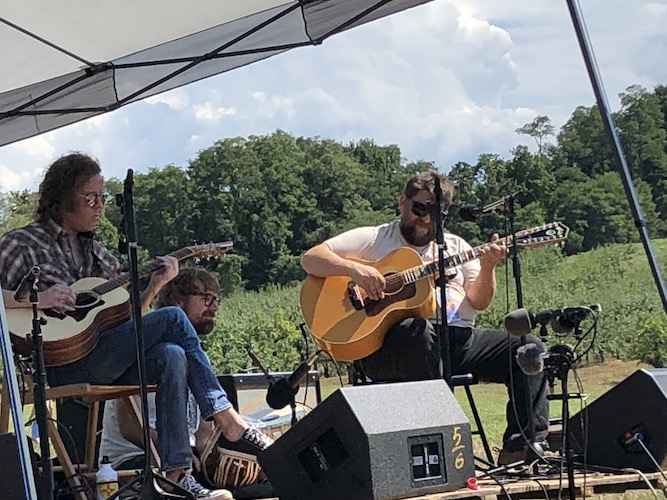
JS: I’ll say just for myself, I consider Shackamaxon, Other Worlds and Red Valley to be sort of one family of music in a way, while the Milwaukee live album is like the step-child of that group. Yet, each one is so different from the others. They’re pretty different from all the rest of our catalog too, which I think is interesting. They all sort of represent different points in the wind down from the pandemic, because they were recorded in that period, while the design and the production work was all happening over the last year and a half, two years. Then they all landed between April and August. I don’t think we planned to have a year of these releases.
DG: Yeah. We weren’t like, let’s get four albums out in a year. It’s just because stuff had backed up under Covid, and then we did a lot of recording, so we had all this stuff around, and it all just came out at once.
DG: Other Worlds was recorded in the middle of Covid, basically. I packed my studio gear in a rental car and went down to Philly and set my studio up in Jesse’s house. Each of the four records has something unique to offer, and for this one, it’s that Jesse’s playing bass on it. So that’s a new thing.
So that’s the studio Covid bass album, the Live at the Milwaukee Psych Fest is a live official bootleg record. Red Valley and Shackamaxon are long form improvisation acoustic music, but the latter of the two is also a collaboration with Mike Gangloff, while Red Valley is multi-track stuff recorded over a long period of time. So each of those has a unique process.
JS: The pandemic sort of threw all the pieces up and then they kind of landed on the board in different places. So we were playing around with different instruments, like the electric bass in my case, or getting more into some of those zither sort of sounds and hammered instruments in Drew’s case.
Other Worlds is like April of ’21. So literally, we had just gotten our second vaccination and we were like, let’s pick up on some ideas that were floating around prior to the Pandemic. The last thing we did, recording-wise, before the pandemic was that Distances album.
DG: The double drummer record.
JS: Yeah, Ian was on that one. The last part of that session was us playing around with me on bass a little bit, and there’s some super fried sounding jams that never got released from that session. These ideas were kinda sitting in our head, as we were going through the pandemic. Then when it was time we could finally play with people again, one of the first things we wanted to do was just see what that sound was and further develop it. I had been jamming on bass with some other people during the pandemic. I had been basically playing mostly acoustic and 12-string, obviously, and had put the bass down after playing it for many, many years prior. I felt like my facility with the bass was starting to come back, and some of the ideas that I was having about what I wanted to say with it were back on the front burner. So that album just sort of grew out of those conversations.
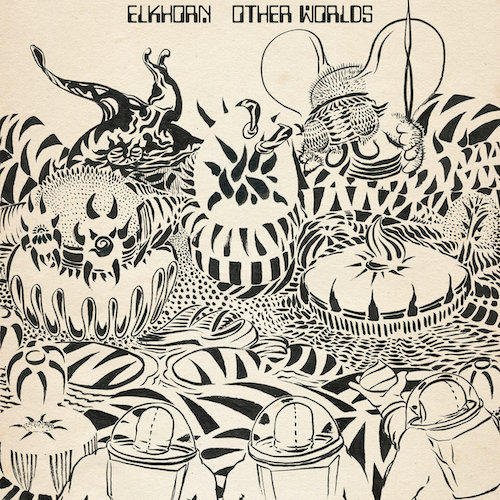
JS: Drew had been spending a lot of time during the pandemic thinking about recording techniques. He invested some money into microphones. He recorded that whole Other Worlds album, and I think it’s one of the best sounding recordings we’ve done. Those skills and those ideas were flooding out because we were looking for opportunities to play and just trying to figure out it was. Then it takes years to develop like, okay, what is this? What tracks do we wanna use of the ones we recorded, how do we wanna mix it? Are any labels gonna be interested in this? It’s such a different sound for us. We weren’t even sure what it was until we had a chance to listen back to it a bunch of times.
[This album is] so different in the sense that a lot of people say our music has a quality to it that is rejuvenating and kind of affirming. I feel like the sounds on Other Worlds are just dirty. It’s not trying to make you feel better the next day. It’s like shit can go wrong. It’s that kind of sound.
DG: For me, I was letting loose a little bit. I guess that is how I would describe it. It was a stressful period. I don’t think it sounds that different from our other music, it’s just the instrumentation is different and the attitude is different. However, if you listen to Jesse’s bass playing in that, it all sounds like Jesse Sheppard phrases in the same way that his 12-string phrases sound like Jesse Sheppard phrases. I’m playing more aggressively and probably with more abandon, but that happens to be the mode that I was in right at that moment.
JS: Some of that is super loud and heavy, too. I think one of the differences maybe is that stuff on Other Worlds is truly improv. It was the first time we ever played it. The Milwaukee album is an album that is a reflection of a band that’s been on the road together for 10 days, and then runs through the material with all of that [experience and practice] behind it.
DG: Other Worlds was very fresh. if you repeat something too many times, the danger is it can get stale.
JS: I do wanna add one more thing, which is the session that the Other Worlds album came out of was like a day long. We just recorded a ton of mind-numbing jams. So one of the first problems we had when we looked at the material was like, where is this album? Is it a double album? Is it a single album?
I think we wanted to pare it down as much as we possibly could. That process added this other development, this other element to it, which was like, what is the overarching theme we wanna create about this album? Drew and I came up with an overall theme that is represented in the artwork and the song titles, and some of the sounds. There’s a whole bunch more material, and it’s even in the same family. So there’s more where that came from. I couldn’t tell you when or even if it will come out.
DG: The outtakes are cool too. We just put up this bonus track that gives you a sense of the flavor of the outtakes. It’s on the Elkhorn Bandcamp site that has something that’s not on the record, and it also has zither on it. I’m also doing a dub remix of it.
This album was in tribute to Sunrise Ocean Bender, so I was wondering if you could talk about your memories of the label, the label head, Kevin McFadin, and how you wanted to channel the spirit of SOB through your music?
JS: Well, that was like a totally other level of this record. It’s sort of born in that stew of feelings around that and the relief of being able to be together socially and musically with Drew and Ian for me. Then we started looking around for a home for it. I think it took a little while and we were a little frustrated, being not exactly sure if people were gonna get it. Like I said, we were especially thinking like, is our audience gonna follow us over to the sound? Then I reached out to an old friend, of whom I had talked to about other projects that had never worked out. We had not been on the same page at the same time.
This friend of mine was Kevin McFadden, who was a radio DJ and just a music lover and supporter, a graphic designer, and he was running the Sunrise Ocean Bender label. Since they’ve been putting out heavier psych rock stuff by friends and awesome bands that I admired for a long time, I thought, actually, this kind of makes the most sense. This fits his label really well, and we’ve been looking for an opportunity to get together. I should probably talk to Kevin about this. He heard it, and he was super positive and into it. He was working with another guy named Kevin Moist from Deep Water Acres on some projects.

So it seemed like a great fit. Then as we were lifting off, and Kevin was talking to us about the scheduling for the release, he passed away. Of course, obviously when a friend who’s in your same age range, a cohort, passes away suddenly with a kid and a wife…I mean, that hits you pretty hard. I think our reaction was like, let’s hit the pause button, see where things go, and over time it became clear that Kevin Moist was still committed to the project. He reached out to a few other people at Feeding Tube, and Dave Cambridge at Cardinal Fuzz in the UK just to have a little more organizational heft behind it.
We were feeling like the best way to honor Kevin was to go forward and release the music and keep him in our hearts as we were going through that process. I feel like we did that pretty effectively. Again, I would’ve loved for him to be involved in those later stages, because he had such a strong personality and opinions about stuff like that, but I think we felt we did it in an appropriate way and that meant a lot to me, as we got through it to the end. So it was pretty cool.
What are some of your favorite memories of Kevin and, and the label?
JS: I know on his radio show, he was always super supportive of not just our music, but everybody’s music in the scene.
In terms of the label, I mean, again, Kevin was someone who came to some of our first shows, down south in Richmond. So lots of memories of phone conversations, like bullshitting about music, and his personality and his very specific sense of humor. He was just a guy who was very involved in the music, but then was also sharing with me his family and what he was going through on a daily basis. I’m sure if you knew him or talked to him, you had the same experience. So my point is, you got a full sense of that guy and how music and art worked in his life, and that was so inspirational, especially when he was reacting to your music in a positive way. So it was just a great loss. Again, for me, just a reminder that every day is a gift. So if I stub my toe, I try to remind myself to appreciate that you stubbed your toe. Some people aren’t around to experience that. Try to be there in the good moments and the bad. That’s my take on it.
Shackamaxon Concert (with Mike Gangloff)
So Shackamaxon Concert is you guys jamming with Mike Gangloff, from Pelt, Spiral Joy Band, Eight Point Star, and other great bands. How long have you known Mike’s music and what was it like incorporating his style of playing into your jams?
JS: I mean, how long have I known Mike’s music? Mike’s like a Matt Valentine or a Jeffrey Alexander, to some extent. You know, one those folks who have been part of the scene since the nineties. They’re like the grandfathers of the music scene that we’re sort of part of now. Mike’s influence and impact on the music scene that we’re talking about is pretty much impossible to quantify, because he has been part of so many important aspects of this sound. So I’ve known his music since the beginning. Some of those early Black Dirt albums with him are just amazing. I had known Mike and corresponded a bit and we had run into each other at various things.
Again, though, you have to understand how this looks in my mind, because the last thing we did before the pandemic was a week through the South with Eight Point Star, which was Mike’s band with Isak Howell. So basically, that was the last thing I remember. We went into a music store in DC and there was hand sanitizer in the store, and I was like, that’s weird. Then the next week, the world was slammed shut. So when things started opening up, and we were lifting the roof off a little bit, and trying to get some sunlight onto the music, one of the first things that happened was Mike said he was going back on tour and was planning on coming through Philly. I was like, well, let’s use this as an opportunity to pick up on some of those threads from two years ago, and maybe do some recording together. How are we gonna do that? We’re just gonna do it on stage as an improvisation.
Basically the conceit of that live show was that we were gonna bring mics and record as a trio with Mike and create this very acoustic sound without a drummer. I think for me, again, that’s the real distinction between the different albums, because think about Ian’s contribution to the Milwaukee set and the Other Worlds album. Then you’ve got the no-drummer sort of sound, where Jesse’s thumb serves as the drummer, like on the Shackamaxon album. Then you’ve got the frame drum of the Red Valley record, which we’re gonna talk about next, which is really like another iteration of how the drum works in the Elkhorn context.
So by taking the drums out and adding Mike in, you get this very flowing acoustic sound. Drew’s playing acoustic guitar here, and the whole sound of the band just shifts. We really used it to kind of spread out on some longer suites. As a band – that is to some extent known as a live band – we had never actually put out a full vinyl LP of live music. So it was nice to be able to tick that box.
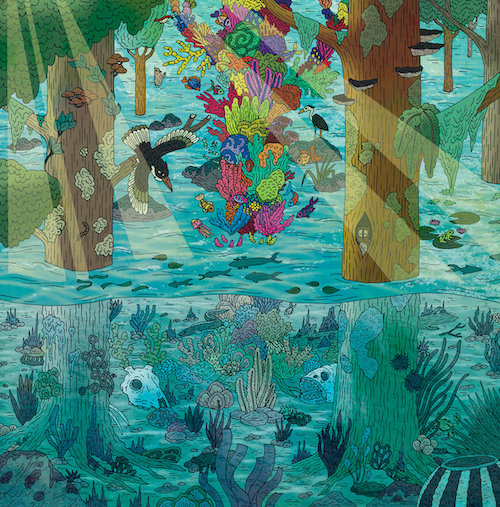
DG: To answer your question about Mike’s playing, we both like all of the projects that he’s done a lot, we toured with him and we had a blast hanging out with him and playing on tour. As the gigs started to happen, each one we would do a little bit more collaboration with them. So that’s how that came together. With Mike’s playing style, it is involved in a mixture of genres that is related to stuff we do anyway. He’s playing from a part folk music tradition, part Indian music tradition, and part avant-garde and drone music tradition, which is something we were already doing. So it was a pretty natural blend.
So then from there, we can move on to Red Valley. When was this one recorded? What led you into taking on this more acoustic, Alice Coltrane-like direction?
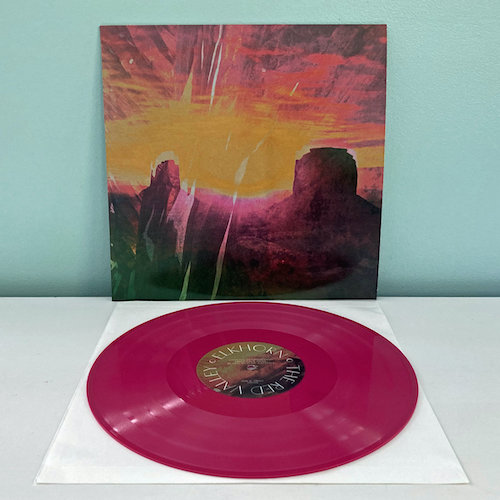
JS: So I started writing down the actual dates of when these things were recorded and when they came out, because it is complicated and mixed together. So in late October of ’21, the people who do the Psychedelic Sangha events in New York, Ethan Covey and Doc Kelly, they were basically doing this guided meditation series for their Bandcamp. They approached us about doing something like that and we used that session at Drew’s as an opportunity to make some really patient music, and to integrate a few different instruments that we hadn’t really been playing within the Elkhorn context. That thing came out on their Bandcamp in January of the next year. Then Drew went back through those tracks and found some of these amazing vibraphone and 12-string tracks and laid drums over those, which then became the On The Whole Universe in All Directions album that Centripetal Force put out in April of ’23.
So those were the same sessions. Then there was still some additional stuff that we had done in that same session in late ’21, which was frame drum and 12-string. Unlike the vibraphone stuff, it didn’t adhere quite as well. I mean, the vibraphone still needed another layer of drums to present itself to us as what it was, but these frame drum pieces were even a little bit more sketches of ideas
DG: This is the process of us getting into multi-tracking sound. Like what Jesse said, it was part of this long session where we did a lot of different things. I was looking over the tracks that were me playing frame drum and Jesse playing 12-string. There’s lots of material there. It sounded really good as guide tracks. It sounded like there were songs all around it that we just needed to record, and that’s what we did.
JS: We’d never multi-tracked. We were always going in and getting one or two takes to get this thing done, and then pick one of those two recordings, and then that’s the album. We had done minimal editing in our entire career, and it was all live to tape, and that was kind of the sound of the band.
Then you think like, what are the American primitive influences on Elkhorn? One of the things that is a value in American primitive music is just dropping it and going on to the next thing. Like, Jack Rose was sort of a one take wonder. So that was kind of a value of mine, and this was just an opportunity to just completely put that aside and be like, okay, what’s possible here? Instead of developing everything horizontally, how could we build it up vertically?
This idea that struck me from working with Jesse Sparhawk, who’s been a friend of mine in Philadelphia for a long time that I have played a couple of duo sets with. I had a guitar and Drew was playing the zither, and Jesse was playing the harp. I realized something’s going on here. Then all of these things started developing, and then as the songs were coming into shape, you could really feel that momentum of a real record building. We found we could really sculpt a shorter piece into a longer piece, with several different phases that that piece could go through. Adding bass underneath a 12-string part, of which I hadn’t done before, adding in a Weissenborn, of which I had never really played on a live album before. So there were a lot of different elements that we were able to stack. Then Drew did this really beautiful session of mixing to create this really cohesive feeling album. I don’t think we’ve ever really been able to create that feeling before.
DG: It’s a layered but normal process for a rock band, totally normal multi-track layering, and this is the first time we totally dove into it.
What challenges did you face with bringing the frame drum into the mix?
DG: Well, frame drum? First of all, I was just excited to be able to do it. I had been playing hand percussion for a while, doumbek, and for the last couple years before that, the frame drum. However, the frame drum had come into the picture fairly recently, and I was enjoying it. We both really liked the way the timbre of the frame drum blended with the acoustic guitar. So that clearly worked. That’s sort of what opened up the whole concept of how the recordings sounded like guide tracks now. This great rapport between the tone of the frame drum and the tone of the 12-string was a great place to start. Then we had the rest of the canvas to fill in.
So when you create a dense, psychedelic atmosphere acoustically, like you do on this album, what sonic qualities do you try to emphasize or tend to reach for more since you don’t have the benefit of amplification?
DG: Normally I would hit a pedal here and there’s a different texture, right? This is a good example of when you can’t do that to help arrange a song. The texture of the instruments when recording in a direct way, acoustically, is what it is. So then in order to create transformations, you can do extended technique or you could basically come up with different ways of using musical forms, rhythmic displacement, different ways of approaching melody and rhythm, just straight up traditional musical stuff in order to do that. So when playing acoustically, we’re not really extended technique people. So it’s all about changing the musical landscape as you go, and letting the richness of the acoustic tonality be itself.
JS: We have a bunch of tools in the toolkit. Some of it’s like what mode or the character of something being major or minor, different open tunings. There’s a lot of different things we can use depending on where we are.
DG: You were asking before, what was the challenge to doing it in this way? One of the challenges that we now have is infinite possibility, and that actually can create a lot of difficulty. So saying no to yourself, focusing yourself, these types of basic ways of thinking about creativity then become crucial in another way. You don’t wanna lose control of it because you can do anything.
JS: What Jack [Rose] used to call the detector.
Live at the Milwaukee Psych Fest
So let’s move on to the Live at Milwaukee Psych Fest. You’re with drummer Ian McColm on this one. He definitely sounds like the right man for the job whenever he’s jamming with you guys. What do you guys enjoy most about what he adds to the Elkhorn sound?
DG: Well, obviously he’s this highly skilled conservatory trained drummer, but he just gets our music. He’s involved in avant-garde music, he’s involved in improvisation places with all kinds of incredible musicians, but he’s also a rocker. So when he is with us, he’s more in rocker mode. He’s like the outboard motor on the Elkhorn boat.
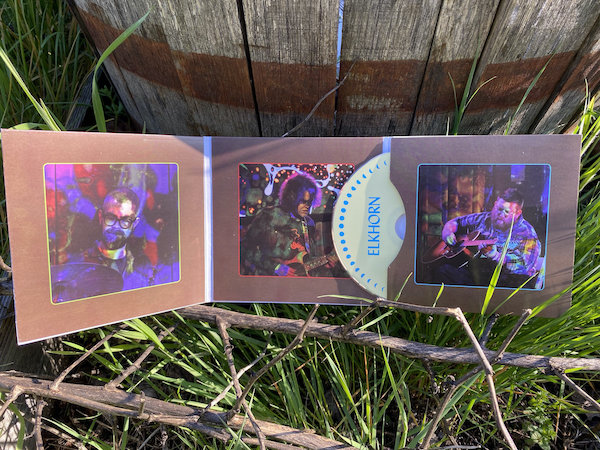
JS: We are a band that’s kind of known for collaborating with a lot of different people, but more so than anybody else, Ian is truly like the third member of this band at this point. He’s played with us and has been a part of the musical development of the band from a very early stage. So he’s been around for the long haul. As Drew said, he’s just a consummate professional and he’s incredibly creative and talented. So it’s both sides of that package.
Again, that Milwaukee CD is the process of getting on the road with Ian and the three of us traveling together and playing in cities all across this great land, and then basically landing on the Milwaukee stage and bringing it to bear.
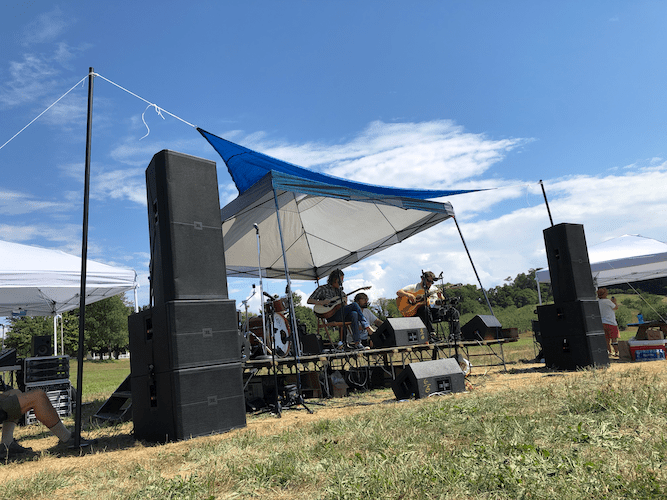
Milwaukee was just a great experience all around. We knew when we came off the stage that the set was a powerful set. So whatever bumps and lumps there may or may not be in the recording, we knew if we had an opportunity to get it out there, we needed to take it to share the recording with the people.
DG: You could sense the audience too. The audience there was very high energy and very focused. Just sparks coming off the audience. So you can kind of hear that in the recording.
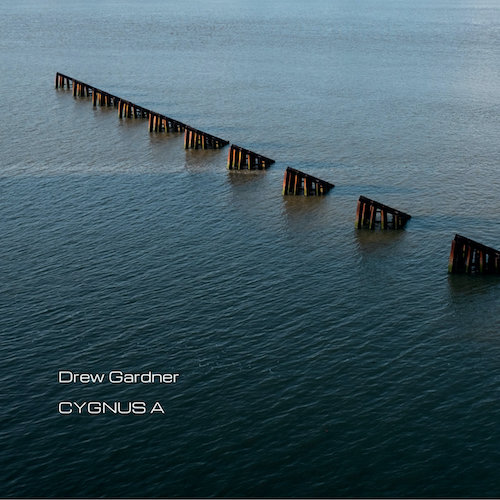
I really love how cosmic the music on Cygnus A is, and yet how also earthy and organic it feels at the same time. So Drew, how did you find that balance? Did you find it organically?
DG: Well, we did. With the circumstances of it, the setting was similar to these other recordings, as it was very much a late Covid recording, too. That was done with me multi-tracking all the tracks in my home studio. It was a record where I’d been playing a lot of zither, so I knew I wanted to try the zither thing. I was also doing stuff around the house where I would play stuff just for pure mood control. During Covid, one of the things I found for mood control, was privately playing music for myself with smaller instruments and instruments that are just easy to grab. I don’t have to plug anything in, or I don’t have to arrange or take it out of a case. Like a thumb piano, or the zither.
I felt I could make a record out of this. I could hear a record here. The textures I liked a lot, too. So basically I knew it was going to be a zither record, and I could kind of hear where the guitar was going to go, so I realized I needed to play guitar, too. A funny thing about that record too, is that since it was Covid, I wasn’t seeing anybody except for whomever I’d run into in Harlem. So my birds were my audience. I have two parrots, and I wound up being interested in what the birds liked, but there were certain things that I’d be playing that would make the birds feel soothed. I was like, I like those things too. So I’m gonna focus on this material.
JS: So when we say that this album’s for the birds, we’re not insulting you at all.
DG: Exactly.
Were the songs for Cygnus A generally improvised as well?
DG: It’s not unlike the Elkhorn process. There were basic arrangement game plans for the songs where I was like, okay, on this song it’s gonna have this basic form, it’ll have this basic change, it’ll have this rhythm, it’ll have this mode. So the same kind of process as I would do in Elkhorn. I was generally doing my own mostly improvised music, but with a pretty deliberate structure.
Are you an avid stargazer at all? Are you interested in space?
DG: I’m interested generally in science and knowledge about the universe, so it falls under that heading. One of the things where that came from was that also during Covid, in the sense of people being very far away, I got into reading about radio galaxies because they’re basically radio stations. So Cygnus A is a radio galaxy. It’s a very, very powerful radio station that is broadcasting with the energy of a black hole. So I did do a lot of reading about that and got interested in it. I’m feeling here that the whole world is very far away, but with radio you could be getting a broadcast from somewhere. They had these old radio stations from Mexico that were called border blaster stations, back in the day, that were wildly overrated, super powerful stations that could be heard over the entire country. So I got interested in that sense of being far away versus what the medium of radio could do to bridge a distance.
Vatic Folk (Jesse Sheppard & Jeffrey Alexander)
So Jesse, what can you tell us about Vatic Folk, the new duo project with Jeffrey Alexander?
JS: Real simply, Drew’s up in New York, while Jeffrey and I are down in Philly, getting together. One of the things that came out of the pandemic was me wanting to just make sure I did more to incorporate more jamming with friends into my life, and in a way that was not super serious or for something that was being recorded for posterity or whatever. So the music came from just the two of us enjoying spending time together. It’s also me constantly wanting to expand the way I approach the guitars as much as anything else.
One of the reasons why I like playing with Jeffrey in the Lidders band is because he’s just a really open musical person. He’s down for everything and is really supportive. He has a very specific language that he’s working within, and it’s interesting to see how my specific language and his specific language could overlap. We were getting together not really thinking of it very seriously at all, but then over time, we listened back to some of the things that we’d recorded and we were like, hey, some of the stuff sounded really cool. I was really enjoying it.
We’ve had a couple opportunities to play live, so I think you’re gonna see a little bit more of that band as we go down the road.

-KH
Huge thanks to both Jesse and Drew for taking the time to chat and for the multiple hours of amazing music we can all enjoy this year. Please support Elkhorn and all of their projects. Buy their records and catch them live any time you can. You will not be disappointed.

 Record Crates United