
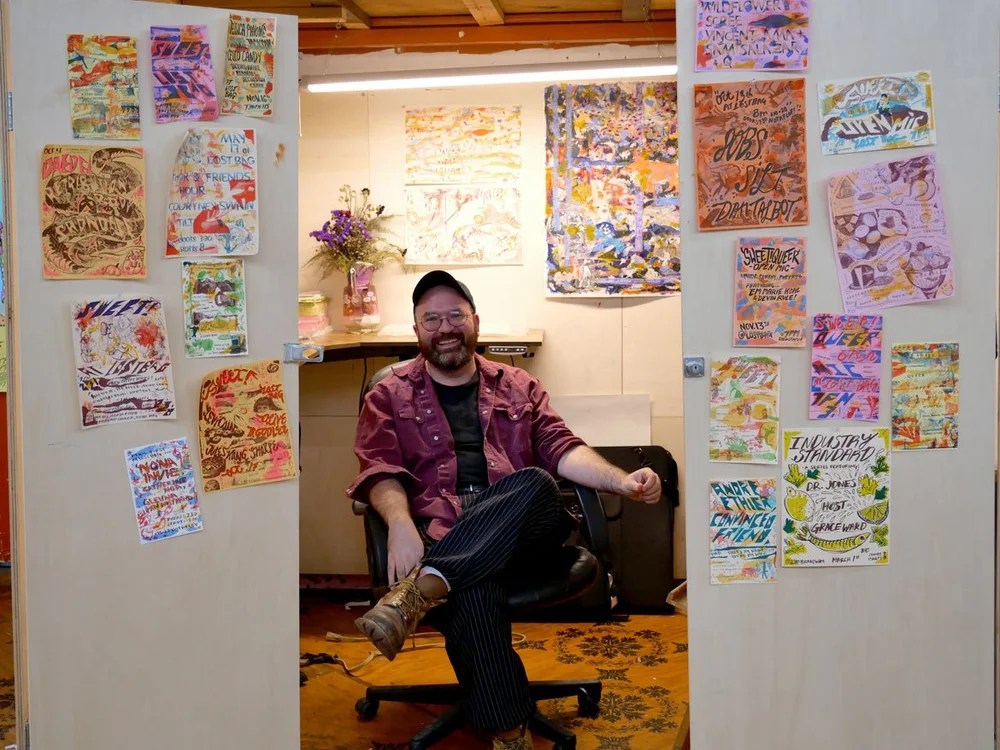
Back in January, I attended the singular rehearsal of Bex Burch’s As Yet Untitled piece at Prototype 237, and I had the pleasure of meeting the opener and co-presenter, Providence-based poet, artist and community arts space co-guardian Q (John-Francis) Quiñonez. We struck up a good conversation, and they shared with me some of their poems to give me an idea of what their set was going to be like. I was immediately struck by their use of carefully deliberate and relatable language, and how a great deal of their work seemed to be inspired by the role music and art plays in the shaping of our lives and our experience. This crossover between the worlds of poetry and music felt right for this site, so when Q asked me about an interview about their work and their new book of poems partially inspired by the goddess Kate Bush, how could I resist?

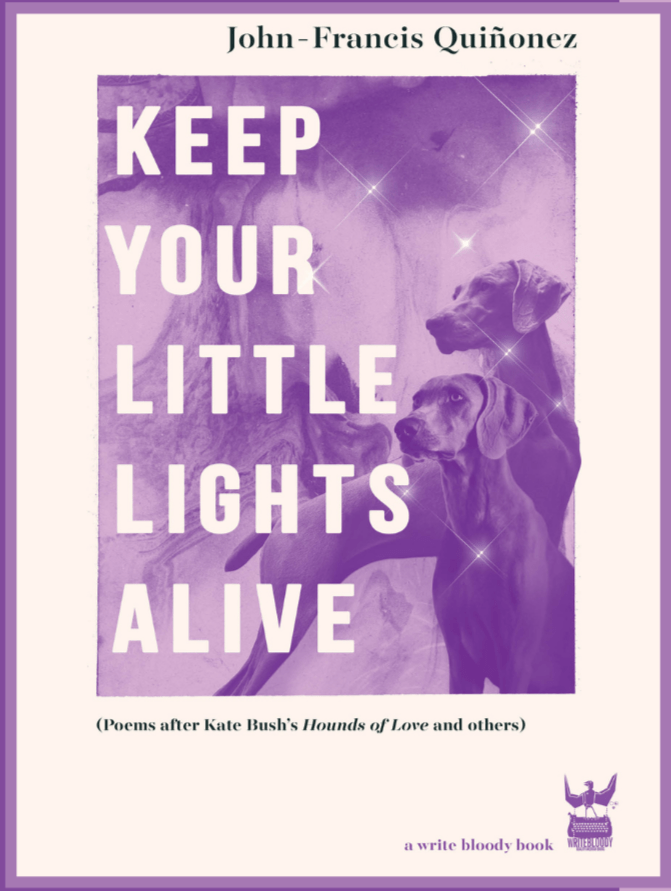
For Q, writing isn’t something that happens in isolation. Poems emerge from accumulated experience music, visual art, conversation, travel, and the quiet act of paying attention. Their latest collection, Keep Your Little Lights Alive, explores the intersections of queer identity, gender, mental health, and family with honesty, humor, and emotional depth. Inspired in part by Bush’s Hounds of Love, this anthology of poetry isn’t an homage so much as a meditation on influence: how the art we love becomes inseparable from the lives we live.
Q was nice enough to assemble a playlist of music that they were listening to and kept afloat by during the making of Keep Your Little Lights Alive. Check it out here.
We caught up a few months ago over Zoom and had an enjoyable chat about their creative process, the soundtrack of memory, and why acknowledging your influences is an act of generosity.
Your work often feels like it exists at the intersection of many art forms. How do you think about influence?
I don’t really compartmentalize any of the layers of my work. Music, visual art, films, conversations, travel, they’re all happening at once. I go out of my way to name stuff that I was listening to, movies that I was watching, other authors that I was reading because all of that is inevitably tied up into the literal work, like the making of the work, definitely, but also literally the texture, the sounds, the rhythms that are showing up in the piece itself. Showing that work and also honoring that lineage and honoring that company is true companionship in my process.
How would you describe your writing process?
I really don’t have a really rigid creative practice. Most of it for me is that I kind of take in the world as it comes to me. I feel like so much of the process for me is taking things in and kind of letting the little Tetris pieces come into place. Suddenly all of those layers interact in a way that feels really playful all at once and with some great urgency. I’m not leading with creative intent, and more like an embodied practice of letting these things come to me and embracing stillness.
Your poems often read as though you’re speaking directly to the reader. Is that intentional?
I take great care to write exactly how I speak. The editing process to me is making sure that I am putting these pieces together in my speaking voice as I would read them to people. I want it to be in the tone of me delivering the poem to you as if we’re catching up over coffee or something. I don’t want there to be a barrier of entry between the poetry as art and me as the person that’s delivering that to you. That closeness is ultimately what I’m seeking.

Kate Bush’s Hounds of Love plays an important role in the collection. How did that begin?
My love for Kate Bush is eternal. Very early on in my relationship to her work, I had a total misunderstanding of one of her lyrics. I thought the lyric was, ‘If I only could, I’d make a deal with God and get them to swallow places. I thought that was so metal. The first poem as part of this central series that carries the book is after ‘Running Up That Hill,’ and is frankly because of that misunderstanding.
Within a couple months, totally by accident, I had a couple of pieces that were also after different tracks on the album. At that point, I decided that I should at least try to pursue it as a restraint.
You have mentioned to me before that some people assumed your book was about Kate Bush?
This isn’t necessarily a book about Kate Bush. This is a book that refuses to compartmentalize that this work and this album was with me and showed up with me during all these pivotal points in my life. Really it is more about the lineage and the ripples of her work. It’s important to me that her voice is not overshadowed by my experience. This is a fully separate thing that seeks to honor her presence in my growth.
Music often appears as part of the atmosphere of your poems. What draws you to that?
Music is almost always present with me. There is just no separation between the layers of my experience. I am having this feeling in my body. I’m having this thought in the cavern of myself. Yet, also, as I’m doing that, in the next room over, I’m hearing the muffled lyrics of a song I’m very familiar with. To leave out any one of those details brings us vastly further from the truth of my experience. I’m always thinking about sound.
That curation and that care and that attention to detail, to not only try to fill all the spaces in an environment, but also make sure that they all have space to shine, is just really important to me.
You’ve spent much of your life around live music and performance. How has that shaped your art?
I have dedicated so much of my life to holding space for live performance. I’ve been a proud co-guardian to multiple venue spaces across the U.S. I’ve worked at every scale. It’s been really a labor of love for a long time. That work and also the true joyous commitment to other art forms, I want to make sure that enthusiasm and that relationship remains in everything that I do.
What kinds of music continue to inspire you?
The albums that are really moving to me stay with me forever. I really love texture, rhythms, layers on layers. That is a quality of music I’m always seeking and find very comforting.
Can you tell us how you built your playlist?
I think for most of this, I really was trying to go back into my personal archives and find the stuff that was really holding me through the making of the work. So a lot of this, like the more contemporary stuff, was all coming out in the summer of 2022. There’s a lot of things here that just showed up in the work in some way or are frankly just inciting pieces of art that definitely influenced how I write today.
You’ve cited unexpected musical influences. Is there one that stands out?
“Feel Better Than James Brown,” by Was (Not Was), is completely to blame for how I write today. There’s a very soft balance between absurdity and humor and matter-of-factness.That artistic quality that is something close to collage has always been really inspiring to me. That collaborative, collage-y, mixed-media experience is something I really enjoy and I’m consistently trying to honor.
Do you find writing cathartic?
“The honesty is always healing. The transparency is always something that I am pursuing. To me, it’s almost like writing out a book of receipts. There are times where reading my own work is really powerful in that way of like, “Wow, look how far I came.” Yet, there are times in the middle of a poem where I’m like, “Oh boy, you really said that you weren’t going to do that anymore.” It’s a very humbling process of keeping receipts.
What keeps you returning to poetry?
I really do write to read in rooms of people. I really don’t expect any of my work to be fully absorbed by any singular person in a room. You remember the time and the space and the sensory. It really is a not-so-small miracle how much a piece of art changes as soon as you let it out into the world. That is what is activating me. That is what keeps me doing it.
What do you hope readers take away from the collection?
I’d love for us as creative people to find more play in exploring lineage and exploring influences. I feel like people are often punished for doing many things.I think acknowledging and exploring and saluting the expanse of everything that is around us is a really nourishing practice. I think it’s our responsibility to push back against that with joy, with enthusiasm, with honor.
To find out more about Q and their work, please visit their website here. To order your copy of Keep Your Little Lights Alive, please visit Write Bloody Publishing.
-KH
